Teaching an upper elementary poetry unit can feel overwhelming, especially when you’re trying to balance structure, creativity, engagement, and standards.
Many teachers wonder: How do I make poetry meaningful without it feeling confusing or chaotic?
The good news? Poetry doesn’t have to be complicated.
With the right structure and clear models, teaching poetry in Grades 2–5 can become one of the most engaging writing units of the year.
When students explore multiple types of poetry, they gain confidence, experiment with language, and discover that poetry isn’t one rigid format. It’s a collection of creative possibilities.
In this post, you’ll find 11 types of poetry that work beautifully in upper elementary, along with practical teaching tips to make your poetry unit organized, manageable, and joyful.
1. Haiku
A three-line poem with a 5–7–5 syllable pattern. Haikus help students focus on imagery, word choice, and syllable awareness. They’re short, structured, and perfect for introducing poetry in a low-pressure way.
2. Acrostic
Students write a word vertically and create a phrase or sentence for each letter. Acrostics are accessible and great for building confidence, especially for reluctant writers.
3. Diamante
A seven-line poem that forms a diamond shape and compares two opposites. It reinforces parts of speech (nouns, adjectives, verbs) while encouraging creative thinking.
4. Cinquain
A five-line poem with a specific word pattern. Cinquains give students structure while still allowing room for strong descriptive language.
5. Shape (Concrete) Poem
The words form the shape of the topic. These poems are visually engaging and highly motivating, especially when displayed in the classroom.
6. Tanka
A five-line poem with a 5–7–5–7–7 syllable pattern. Tankas expand on haikus and allow students to add reflection or emotion to their imagery.
7. Free Verse
No rhyme or specific structure required. Students focus on line breaks, imagery, rhythm, and voice. Free verse allows creativity while still teaching intentional writing choices.
8. Narrative Poem
A poem that tells a story with characters and events. Narrative poetry helps students connect poetry to story structure, sequencing, and clear punctuation.
9. Rhyming Poem
Students practice rhyme patterns like AABB or ABAB while telling a story or describing a topic. This builds phonics awareness and rhythm.
10. Limerick
A five-line humorous poem with an AABBA rhyme pattern. Students love the rhythm, repetition, and playful tone of limericks.
11. List Poem
A poem built from a series of descriptive lines. List poems are excellent for vocabulary development and fluency, and they give students a strong starting point.
Why Teaching Multiple Poetry Types Matters
When students explore multiple types of poetry, they begin to see that poetry isn’t one rigid format. It’s a collection of creative possibilities.
Some students thrive with structure (haiku, cinquain, diamante).
Others flourish with creative freedom (free verse, list poems).
By offering variety, you build confidence, engagement, and writing stamina. Students begin to take risks, experiment with language, and make intentional writing choices.
Poetry Teaching Tips for Upper Elementary
Teaching poetry doesn’t have to feel intimidating. A few simple shifts can make a big difference.
1. Start with Structure
Begin with structured forms like haiku, cinquain, or diamante. Clear expectations reduce anxiety and help students focus on word choice instead of worrying about what to write.
Structure supports creativity. It doesn’t limit it.
2. Model Writing Together
Before asking students to write independently, write a poem together as a class. Modeling strong writing with mentor texts builds confidence. Here’s a great post on using mentor texts to teach writing.
A “We Do” approach:
• builds confidence
• clarifies expectations
• allows students to hear strong word choices
• reduces writing anxiety
When students see the thinking process, they are much more successful on their own.
3. Teach Line Breaks Intentionally
Line breaks are powerful. Poetry is not simply sentences stacked on top of each other.
Show students how breaking a line changes rhythm and emphasis. This helps them understand that poetry is crafted with purpose.
4. Focus on Strong Word Choice
Encourage students to replace simple words with more descriptive ones.
Instead of:
“The dog ran fast.”
Try:
“The dog sprinted across the muddy field.”
Strong verbs and vivid adjectives elevate poetry quickly. These strategies link directly to effective writing workshop practices discussed in this post on writing workshop strategies.
5. Keep It Short and Celebratory
Poetry works best when it feels manageable. Short formats allow time for revising, publishing, and celebrating.
Display student work. Create a poetry anthology. Host a poetry share day.
When students see their writing valued, they take greater ownership. For more ways to build student excitement for writing, check out these ways to help students love writing.
6. Offer Choice
Not every student connects with the same type of poetry. Offering multiple styles allows students to discover what works best for them.
Some students love syllable patterns. Others prefer storytelling. Others thrive in humorous formats like limericks.
Choice builds engagement.
Making Poetry Instruction Manageable
When poetry instruction is organized and structured, it becomes one of the most joyful units of the year, instead of one of the most stressful.
- Clear definitions
- Guided practice
- Structured drafting pages
- Intentional publishing time
- Simple assessment tools
When those pieces are in place, poetry feels purposeful, not overwhelming.
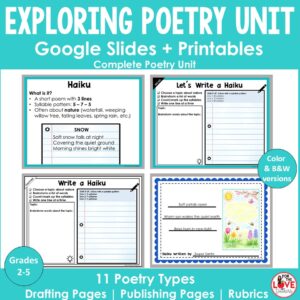
If you’re looking for a complete, organized poetry unit that includes instructional Google Slides, guided “We Do” practice, drafting pages, publishing pages (color and black & white), and rubrics for all 11 poetry types, you can find my resource on TPT here: Exploring Poetry Unit or shop directly on our site here.
Poetry should feel joyful, not stressful, for both teachers and students.
Thanks for reading!
If you like it, then pin it!


Christine Weis is a passionate educator, classroom management coach, wife, and mom of two busy boys. She enjoys teaching, writing, and creating resources for teachers.

Leave a Reply