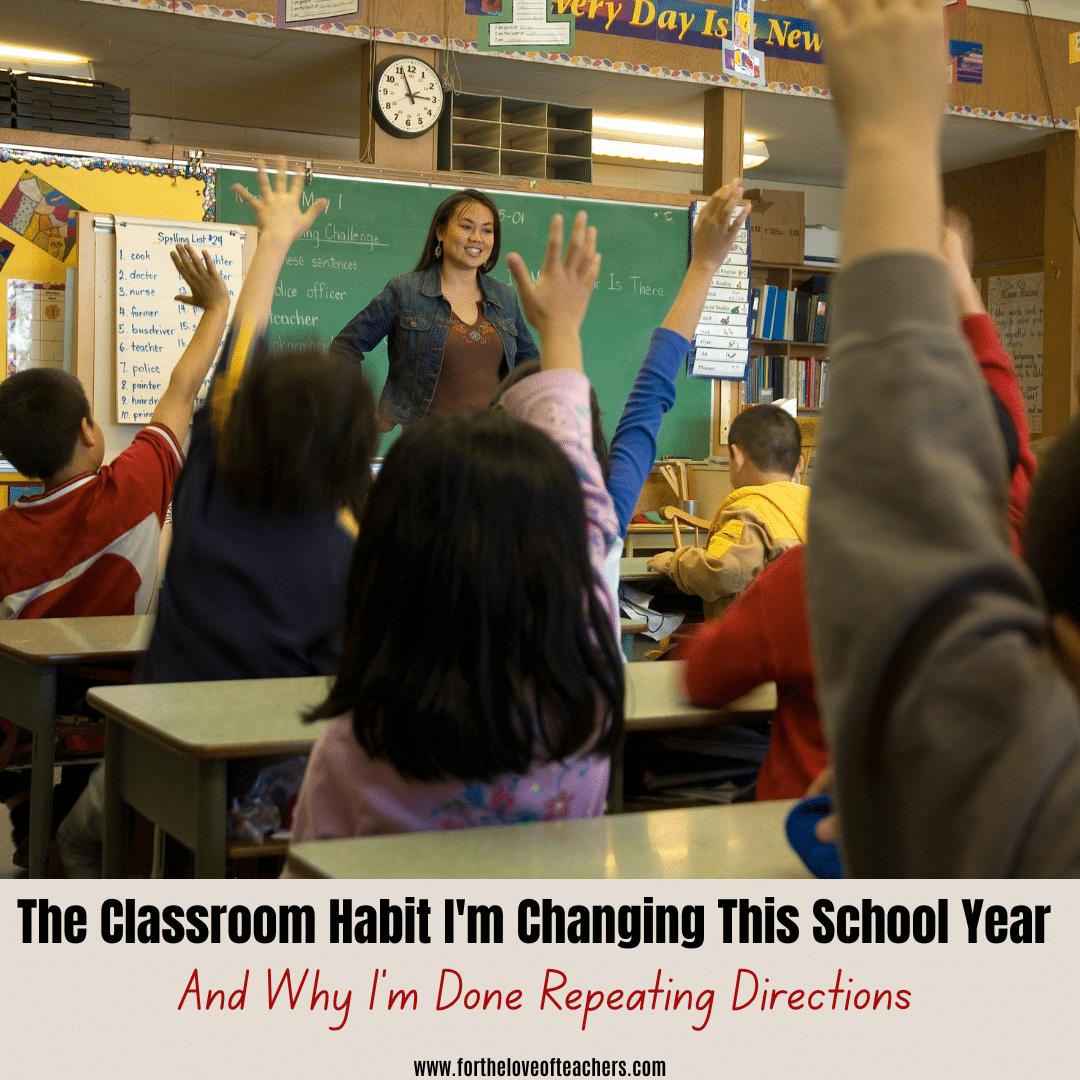
Every summer, after the classroom is packed away and the school year has come to an end, I find myself reflecting on what went well and what I’d like to do differently the following year. Sometimes it’s a lesson that fell flat. Sometimes it’s a classroom management strategy that didn’t quite work the way I had hoped. Other times, it’s something so small that I hardly noticed I was doing it until I looked back on the year as a whole.
This summer, I kept coming back to one habit.
I repeat directions. Not once or twice. More than I’d like to admit.
The funny thing is, I never intended for it to become a habit. Like most teachers, I repeat directions because I genuinely want my students to be successful. If someone looks confused, I help. If a student asks what to do, I explain it again. If several students seem unsure, I stop the class and repeat the directions for everyone.
It feels helpful in the moment. But the more I reflected on it this summer, the more I began to wonder if I was actually helping my students as much as I thought I was.
I started asking myself a difficult question:
What if my habit of repeating directions is keeping my students from becoming more independent?
That question has completely changed the way I’m thinking about the start of this school year.
A Habit I Didn’t Even Realize I Had
If you’re anything like me, this probably sounds familiar.
You explain the assignment carefully. You model what students are expected to do. You answer questions before anyone even gets started. You post the directions on the board or display them on your slides, confident that everyone knows what comes next.
Then, within minutes, the questions begin.
“What are we doing?”
“Where do I write my answer?”
“What page are we on?”
Without even thinking about it, I answer.
Again.
And again.
And again.
For a long time, I assumed this was just part of teaching elementary school. Kids forget. They get distracted. They miss things. That’s normal.
But over the past year, I started noticing something. Many of my students weren’t using the resources that were already available to them. They weren’t rereading the directions. They weren’t looking at the anchor chart we had created together. They weren’t asking a classmate before asking me. Instead, they came straight to the teacher.
And I realized something else. I had trained them to.
The Lightbulb Moment
That realization was hard to admit because my intentions were always good.
I wasn’t trying to create dependence. I was trying to keep the lesson moving. Repeating the directions often felt faster than waiting for students to figure things out on their own.
But every time I immediately answered a question that students could have answered themselves, I removed an opportunity for them to think.
Instead of encouraging them to stop, reflect, and use the resources around them, I unintentionally taught them that the quickest way to get an answer was simply to ask me.
Over time, that became the expectation.
Not because my students were lazy.
Not because they didn’t care.
Because I had made it easy.
Why This Matters
The beginning of the school year is about so much more than teaching classroom procedures.
It’s when we establish habits. Students learn what our expectations are, but they also learn what our responses will be.
If they forget a direction, will we immediately repeat it?
If they have a question, will we answer it before they’ve had a chance to think?
If they’re unsure, will we encourage them to use the tools around them or simply solve the problem for them?
Those seemingly small moments happen dozens of times each day, and together they shape the culture of our classrooms.
As I reflected on my own teaching, I realized I don’t just want students who follow directions. I want students who listen carefully, think independently, solve problems, and take ownership of their learning.
Those are life skills. And they don’t develop if I’m always doing the thinking for them.
When Helping Turns Into Rescuing
Please don’t misunderstand what I’m saying. I’m not suggesting we should never repeat directions.
There are absolutely times when students need clarification. Some students need accommodations. English learners may need additional language support. Others simply need another explanation, and that’s part of meeting students where they are.
But I’ve realized there’s a difference between supporting students and rescuing them before they’ve had an opportunity to think. As I started reading more about student independence, I came across the idea of learned helplessness. It’s the tendency to rely on someone else before attempting to solve a problem independently.
The more I reflected on my classroom, the more I wondered if I had unintentionally contributed to that pattern. Not because I expected less from my students. Because I expected more from myself. I thought it was my job to have every answer. Now I think part of my job is helping students discover that they already have some of the answers. They just need to slow down long enough to find them.
What I’m Going to Change This School Year
This doesn’t mean I’m going to stop helping my students. Teaching has always been about providing support when it’s needed, and that will never change.
What I am changing is how I respond. Instead of automatically repeating directions, I’m going to pause.
I’ll ask questions like:
“What do you remember?”
“Where could you find that information?”
“What does the board say?”
“Can someone at your table help you?”
Those questions still support students, but they also encourage them to think, recall, and use the resources we’ve already built together. It’s a small shift, but I think it has the potential to make a big difference.
Building Independence Starts on Day One
As teachers, we spend a lot of time teaching routines during the first few weeks of school. We practice lining up, transitioning between activities, and using classroom materials because we know those habits will shape the rest of the year.
One thing this reflection reminded me is that active listening isn’t a skill we teach once and expect students to master. Although I already model and teach active listening at the beginning of the school year, it’s something we need to revisit often. Just like classroom procedures and expectations, active listening requires ongoing modeling, practice, and reinforcement if we want it to become a habit.
We’ll continue talking about what it means to SLANT and to listen with the intent to understand, not just to hear. We’ll practice using anchor charts, written directions, and classroom resources before asking for help. We’ll celebrate students who pause, think, and persevere before immediately relying on the teacher for answers. Those small moments build independence and accountability over time, which is something I also talk about in my post, Teaching Accountability in the “I’m Bored” Era.
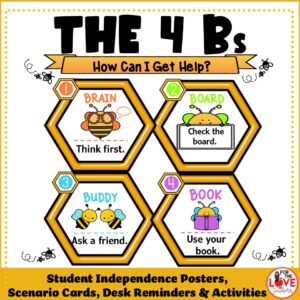
Try the 4 Bs: Brain, Board, Buddy, Book
One simple routine I use to help students become more independent is the 4 Bs: Brain, Board, Buddy, Book.
Before immediately asking the teacher for help, students can stop and think, check the board, ask a buddy, or use a book or classroom resource. It gives them a clear, kid-friendly way to problem-solve and use the supports already around them.
I created a 4 Bs Student Independence Classroom Routine with posters, desk reminder cards, scenario cards, sorting activities, reflection pages, and a teacher guide to help teach and reinforce the routine.
Shop the 4 Bs Student Independence Resource here, or on TPT if you prefer.
Final Thoughts
Will I still catch myself repeating directions?
Probably.
Old habits are hard to break, especially when they come from a place of wanting to help.
But this year, I’m going to be more intentional. I’m going to remind myself that my goal isn’t simply to get students through today’s lesson. My goal is to help them become learners who can think independently, solve problems confidently, and take ownership of their learning.
Ironically, I think the best way to help my students may be to step back just enough to let them do a little more of the thinking themselves. Maybe that’s the classroom habit that will make the biggest difference this year.
As you prepare for a new school year, what’s one classroom habit you’re challenging yourself to change?
Relevant Posts & Resources:
5 Ways to Promote Active Listening In Your Classroom
Teaching Accountability in the ‘I’m Bored’ Era
Active Listening Modeling Script (TPT if you prefer)
Active Listening Bundle (TPT if you prefer)
Thanks for reading!
If you like it, then pin it!


Christine Weis is an elementary educator and the creator of For the Love of Teachers, where she shares practical classroom strategies, engaging teaching resources, and real-life ideas to help educators create meaningful learning experiences.

Leave a Reply