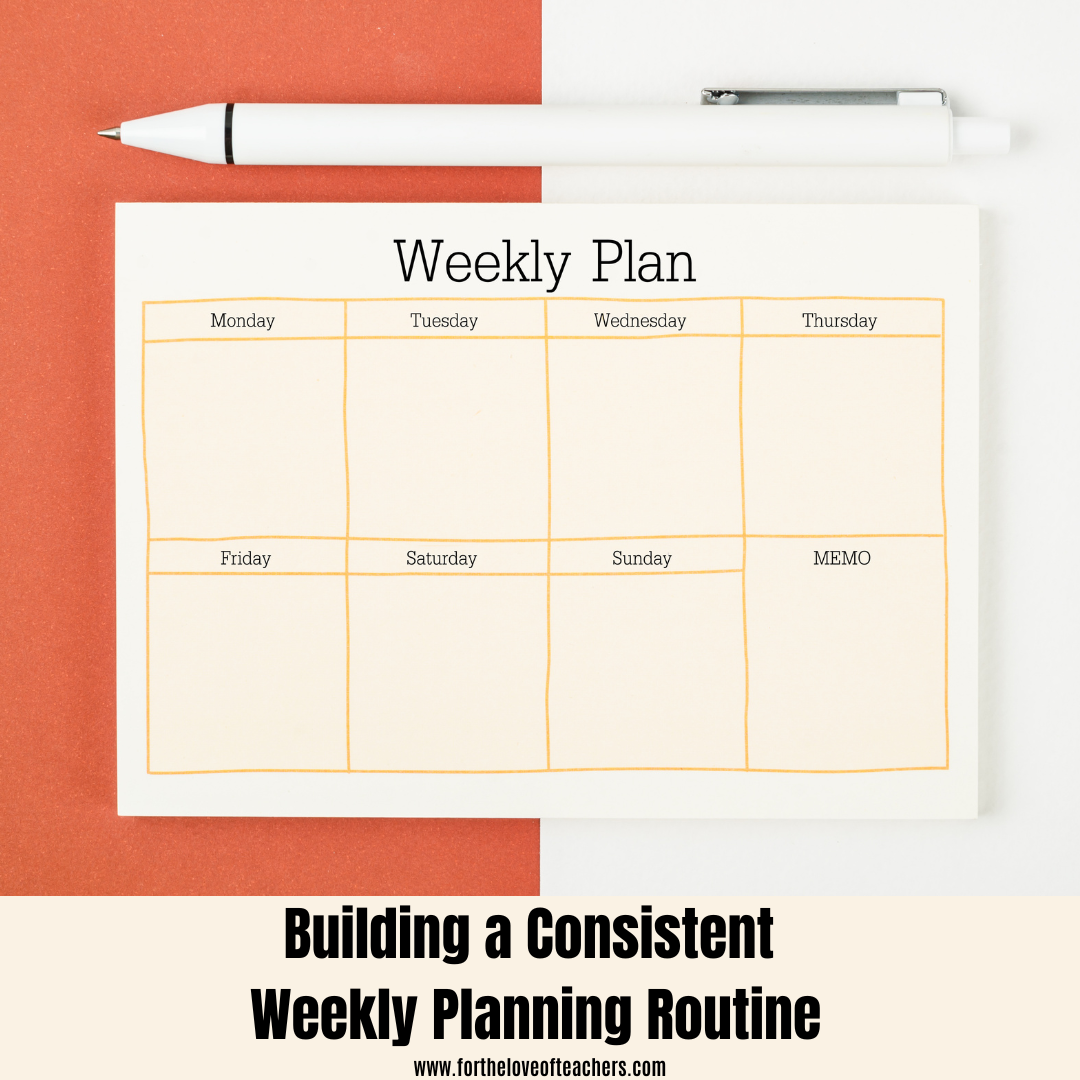
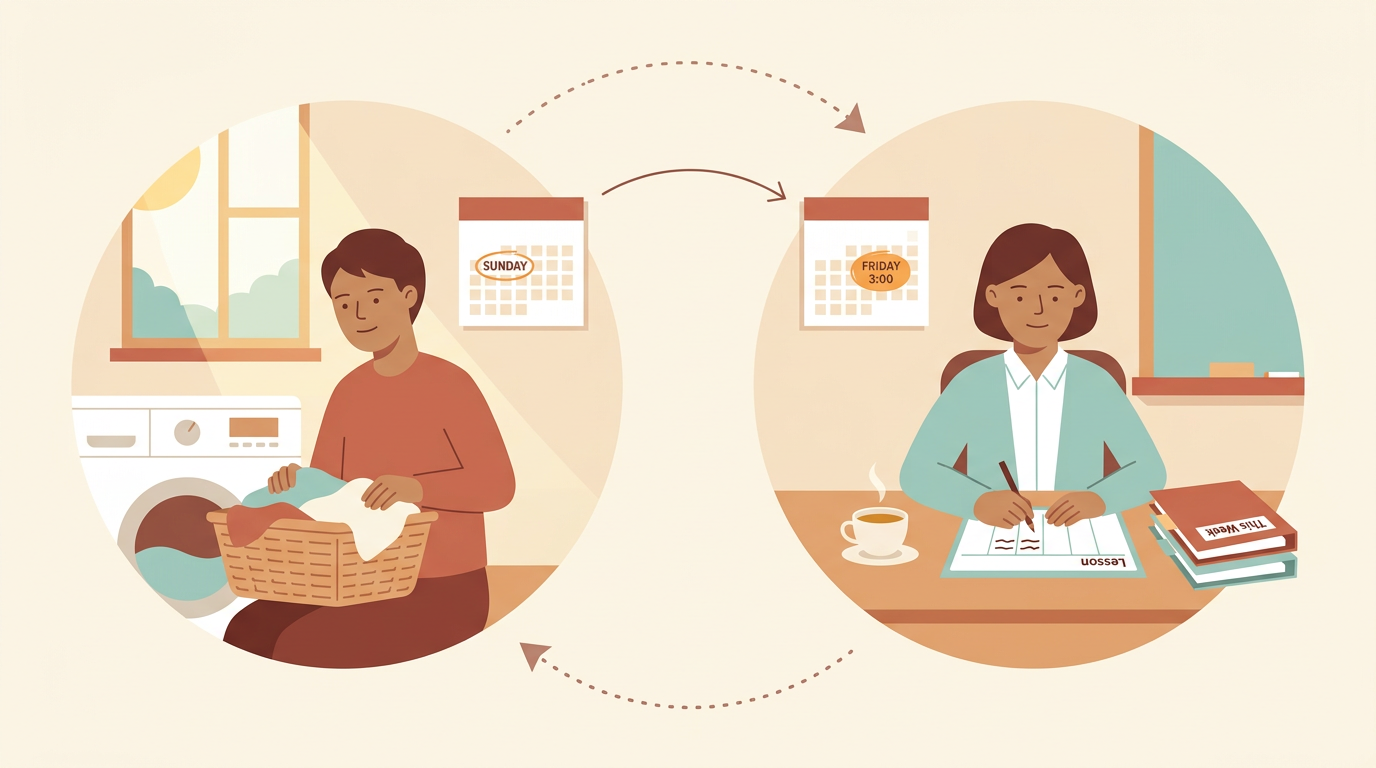
Think about the one household task you never skip: laundry on Sunday, groceries Saturday morning. You don’t decide whether to do it each week; you just do it, because the time is already set.
Weekly planning works the same way. Teachers who stay ahead of the week, instead of scrambling through it, usually aren’t more disciplined.
They’ve just built a ritual anchored to a fixed time, the right inputs, and a quick look back before they plan again.
In this post, we’ll walk through how to build that same rhythm for yourself, step by step.
Why Weekly Planning Falls Apart
Ask most teachers when they planned this week’s lessons, and you’ll usually hear some version of “last night” or “during first period.” That’s not a discipline problem. It’s a design problem.
When planning only happens under pressure, you’re always reacting to the week instead of shaping it. Consider a middle school teacher who plans Sunday night at 9 p.m., exhausted, just trying to survive Monday.
She’s not building a week; she’s patching one. That pattern guarantees a permanent state of catch-up, because there’s never a calm moment to plan from, only a deadline to plan around.
Even teachers who try to fix this with an occasional planning marathon, a full Saturday spent mapping out units, often find it doesn’t stick. Without a fixed trigger and the same repeatable steps each time, a marathon is a one-off event, not a routine.
The next busy week arrives, and the old scramble creeps back in.
Here’s the part that surprises people: willpower isn’t the missing ingredient. You don’t need more motivation. You need a routine simple enough to run half-asleep, one that doesn’t depend on how you feel that day. The real goal isn’t a perfect plan.
It’s a repeatable one, built from a calm vantage point instead of a rushed one. Perfect can wait. Consistent can’t.
Pick One Time and Defend It
The teachers who never scramble on Monday morning didn’t get there through sheer willpower. They picked one hour a week for planning and made it untouchable.
Anchor planning to a fixed slot
Friday afternoon works well because it lets you close the loop while the week is still fresh in your head: what landed, what flopped, what needs reteaching.
Sunday evening suits teachers who want distance first, a chance to walk away from Friday’s chaos before mapping the week ahead. Neither is more “correct.” Pick the one that matches how your brain resets.
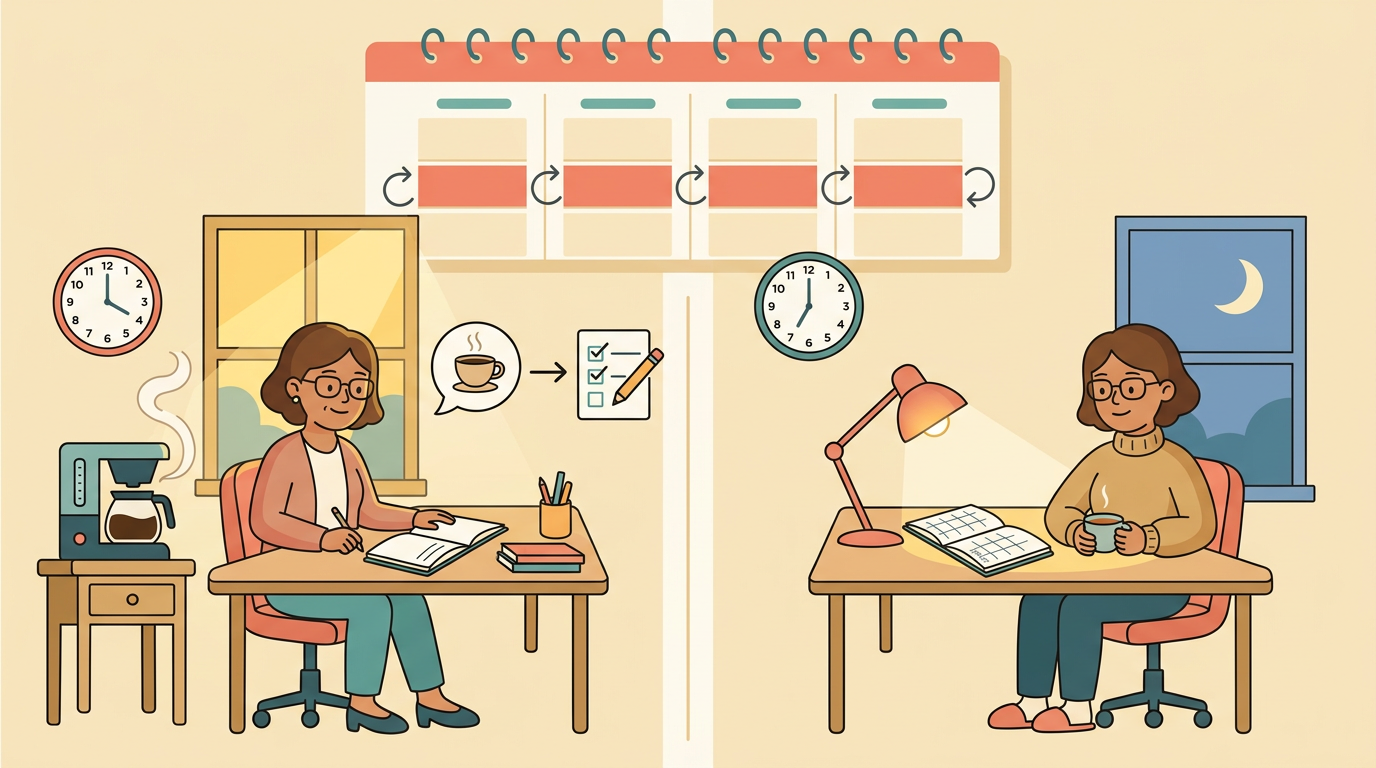
Attach the block to something you already do. A high school English teacher who brews coffee the second the last bell rings can turn that ritual into the planning cue itself: coffee brewing means it’s planning time, no decision required.
Then put it on your calendar as a recurring appointment, the same way you’d block a lesson you’re teaching, so nothing else can quietly slide into that hour.
Protect the block from erosion
That hour deserves the same protection as time in front of students. Silence notifications, and if colleagues keep finding you in the staff room, take your laptop and leave the building if that’s what it takes.
When the block does get bumped (and it will), reschedule it within the same week instead of letting it vanish. Skip it once and it’s easy to skip it again.
Gather Everything Before You Plan
Planning stalls the moment you stop mid-flow to dig up the curriculum map or hunt for last week’s notes. Gather your inputs first, and the real planning stays uninterrupted.
Know your inputs
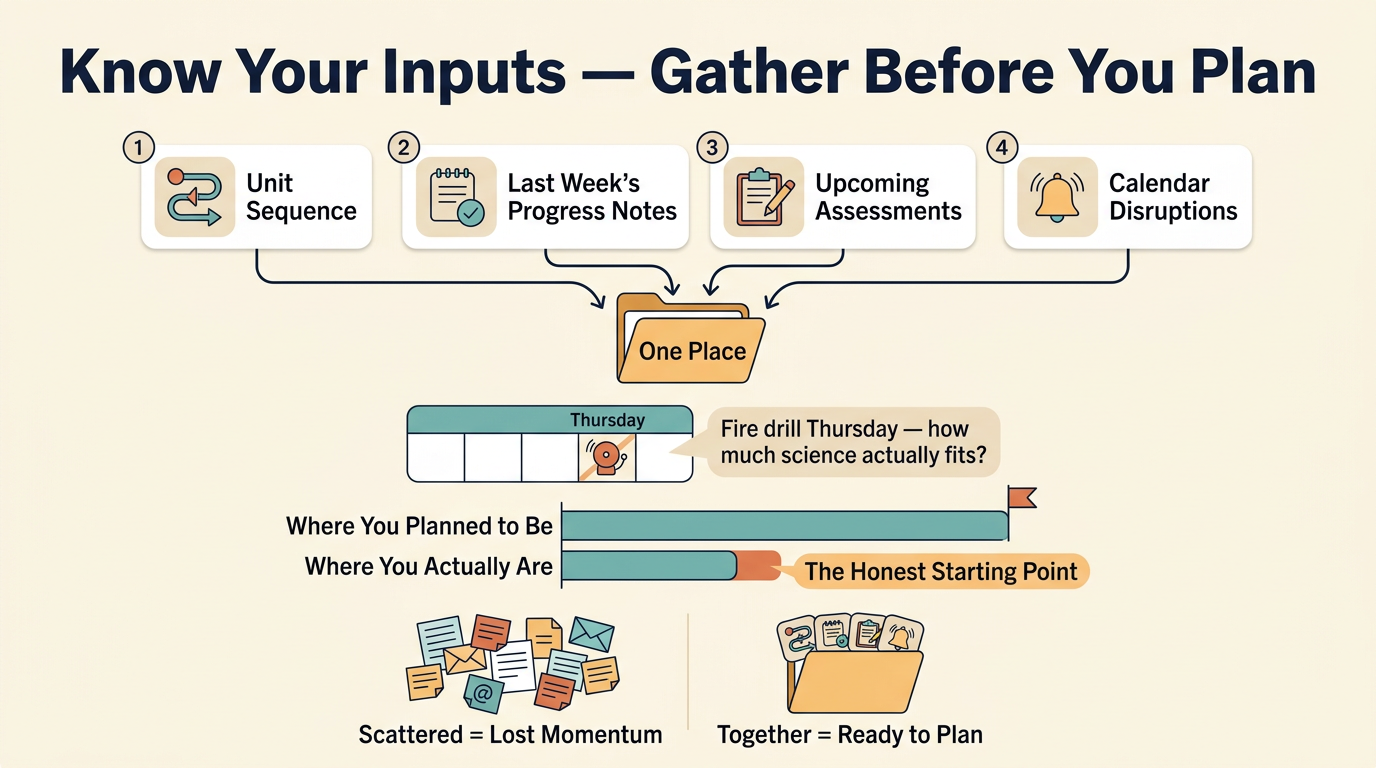
Before you open a blank template, pull together:
- the unit sequence
- last week’s progress notes
- any upcoming assessments
- calendar disruptions like assemblies or early dismissals
For example, a fifth-grade teacher heading into a short week checks the fire drill on Thursday before deciding how much science actually fits.
While you’re at it, note where each class actually ended versus where you’d planned them to be. That gap is the honest starting point for next week, not the plan you wrote seven days ago.
Keeping all of this in one place beats scattering it across notebooks, sticky notes, and email threads. Chase down five different sources, and you’ll lose momentum before you write a single objective.
Keep materials in one home
A lesson planning tool that holds your objectives, resources, and timing in one spot removes the scavenger hunt entirely. Teachers who plan this way in EMStudio, for instance, open one screen and see everything they need instead of toggling between apps.
Digital plans also let you copy last week’s structure and adjust it, rather than rebuild from scratch every Sunday. That alone can turn a two-hour planning session into thirty focused minutes.
What matters most isn’t which system you pick. It’s that your materials live in the same place every single week, so gathering them stops being a task of its own.
Run the Same Steps Every Week
A repeatable sequence turns planning from a creative struggle into a checklist you execute. Follow the same order every week, and you’ll build real speed, because the routine handles the small decisions so your energy goes to the ones that matter.
Work from the week’s outcomes backward
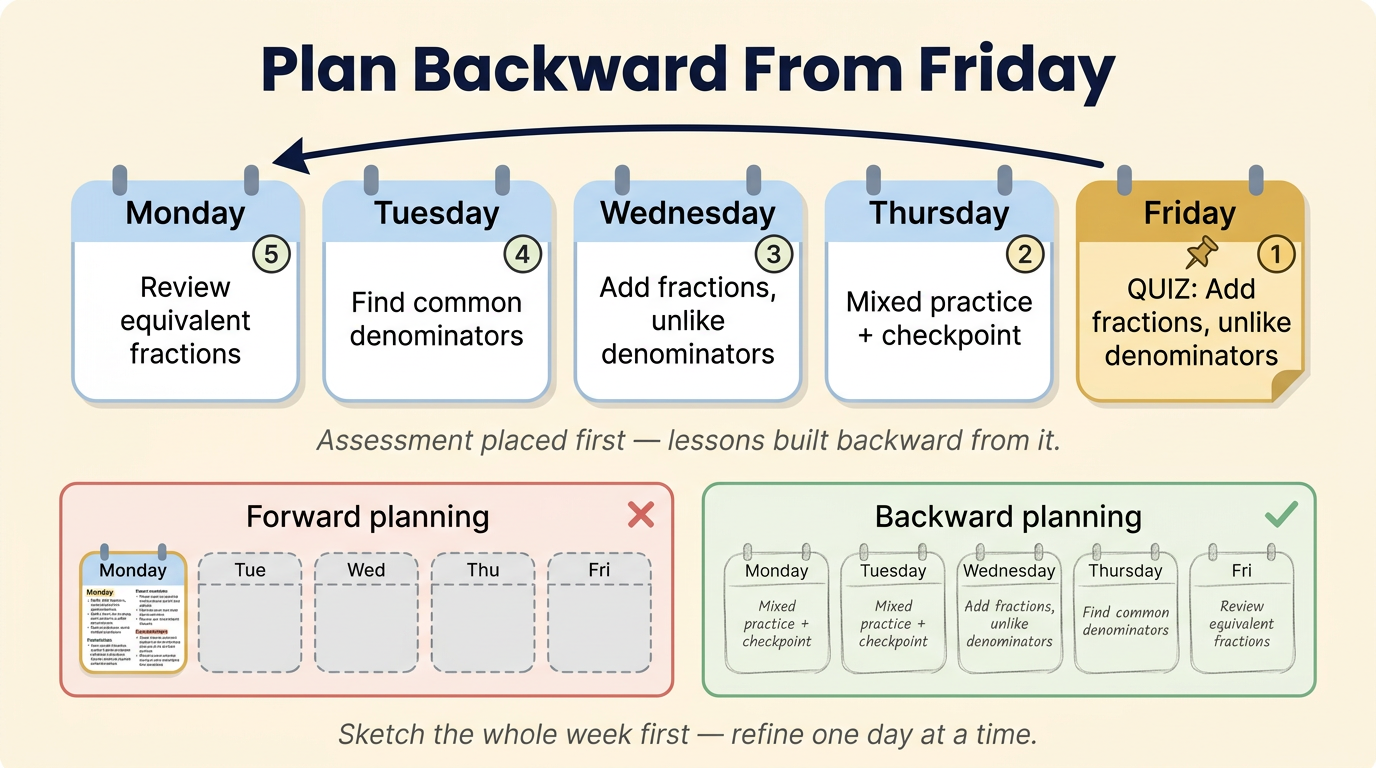
Start with what students should know by Friday, not what you’ll teach on Monday. Once that target is clear, map the lessons back from it instead of forward into it.
Slot assessments and checkpoints in first, then build the teaching days around them.
For example, a fifth-grade teacher planning a fractions unit pins Friday’s quiz to the calendar before touching a single lesson, then works backward to decide what Monday through Thursday need to cover to get students ready.
Draft the whole week in broad strokes before refining any single day. A rough sketch of five days beats one perfectly polished Monday and four blank slots.
Some teachers do this sketching in a planner, others in a tool like EMStudio, where lessons can be dragged around the week without redrafting from scratch.
Build in slack deliberately
Leave one flexible period a week that isn’t assigned to new content. That’s your buffer for the lesson that ran long or the concept that needs a second pass.
Front-load the heavier prep, like a lab setup or a project launch, to Monday and Tuesday, when your energy (and your students’) is highest. Save the lighter, more routine days for later in the week.
Resist the urge to plan every single minute. An overpacked week looks great on paper, but it collapses on the first fire drill, absence, or assembly. Flexible beats full every time.
Stay a Week Ahead Instead of a Day
Being ahead of the week isn’t the same as being ahead of the day. It means Monday’s lessons were ready last Friday, not assembled in a Sunday-night scramble.
That one-week cushion changes what a sick day or a surprise meeting costs you: instead of a crisis, it’s a minor bump.
Build the buffer gradually
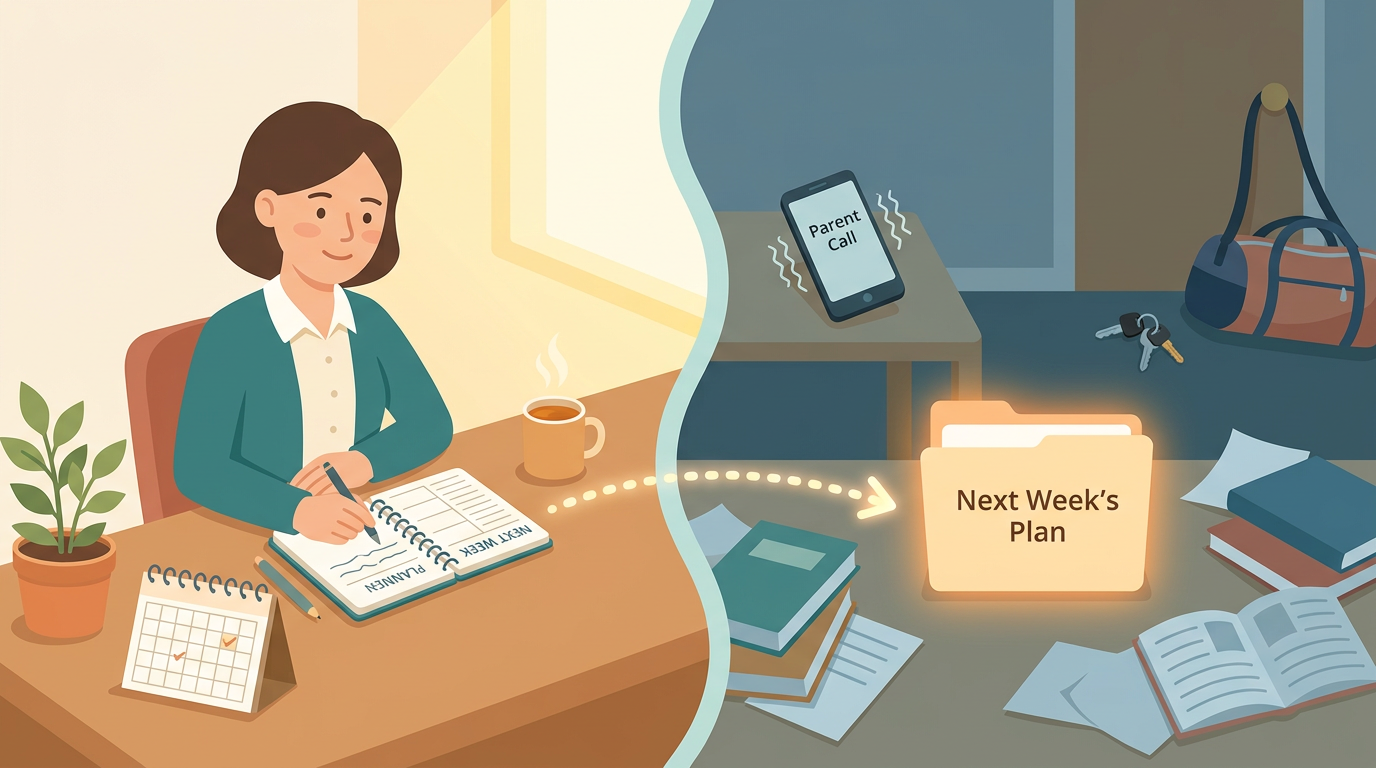
Building that cushion happens one slot at a time. Use this week’s planning session to draft next week’s lessons, so you’re always working one cycle ahead of the calendar instead of racing it.
For the first month, aim for just two days of lead time: enough to feel the shift without overwhelming the routine. Once that sticks, stretch it to a full week.
The payoff shows up the first time an evening gets swallowed by a parent call or a late practice pickup, and next week’s plan is already sitting there, untouched by the chaos.
Let one system carry the load
A buffer only helps if you can actually see it. Managing plans, materials, and your schedule inside an all-in-one teacher planner keeps the coming week visible at a glance instead of scattered across a notebook, a shared drive, and a few sticky notes.
Laid out that way, gaps show up before your students do: the missing worksheet, the day with no clear objective. Fewer tools to check means fewer places for the plan to slip through.
Review Before You Plan Again
A planning routine that never looks backward just repeats last week’s guesswork. Closing the loop on what actually happened is what turns a fixed slot into something that gets sharper over time, not just something you show up to.
A quick review is what makes each week’s data for the next, instead of a fresh guess.
Ask three quick questions
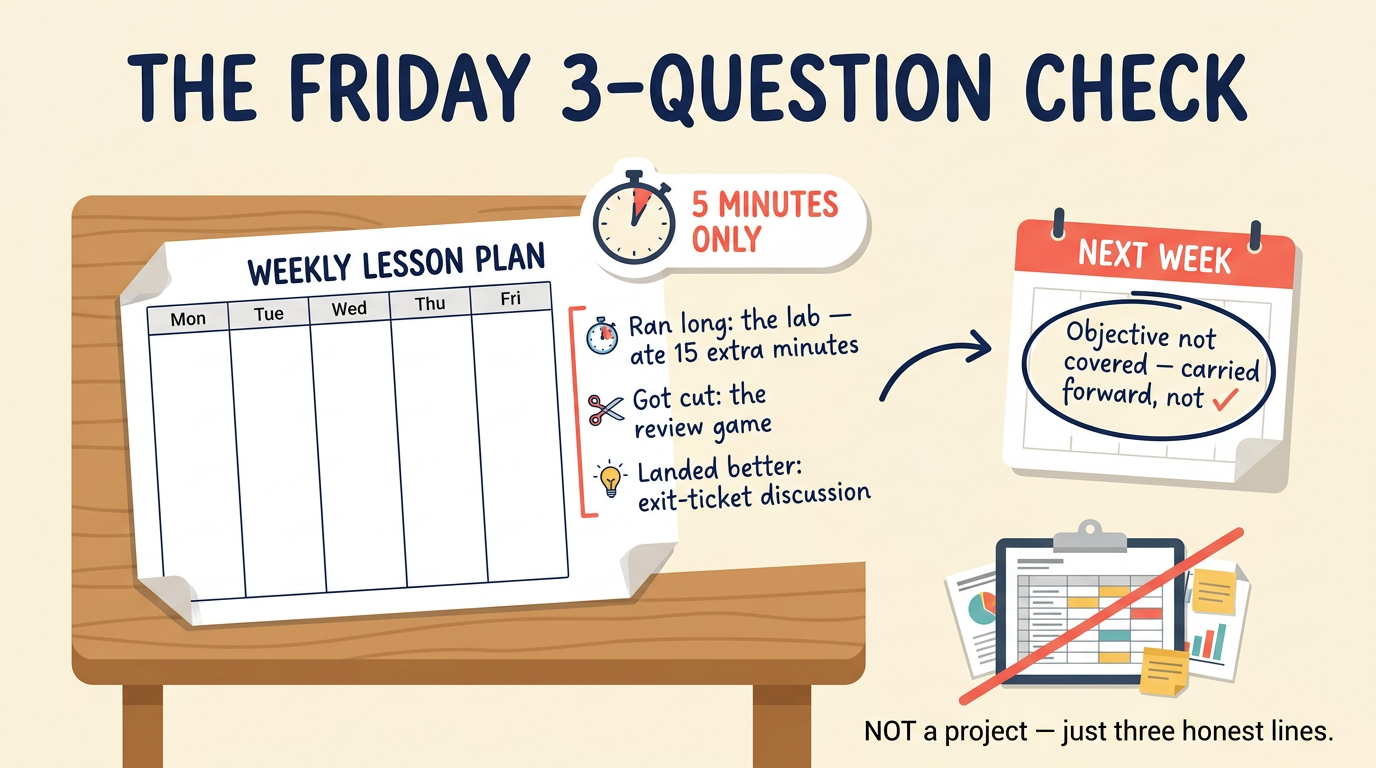
Before you touch next week’s plan, ask three things:
- what ran long
- what got cut
- what landed better than expected?
Answer honestly, not the version you wish were true.
If an objective didn’t get covered, carry it forward into next week instead of quietly pretending it was taught. Skipping this is how small gaps pile up until a unit test reveals them all at once.
Keep the whole review to five minutes. A middle school teacher might jot three lines in the margin of Friday’s plan on the way out the door, nothing more.
The moment review becomes its own project, it’s the first thing you’ll skip when the week gets tight.
Adjust the routine itself
The review only matters if it changes something. If you consistently run out of time, shorten the scope of what you plan, not the slot you protect for planning it.
Notice which prep tasks you keep pushing to “next time.” Either give them a real spot on the calendar or drop them for good.
And if your fixed planning time keeps getting crowded out by meetings or duty coverage, treat that as a signal to move the slot, not to give up on having one.
Make the Habit Survive a Bad Week
Even the most consistent teacher has a week where planning falls apart. A sick kid, a report card deadline, a Sunday that vanished. That’s not a failure of discipline. It’s just life, and the habit’s real strength shows up in how fast you get back to it.
The rule that matters most here: never miss twice. One skipped session is a blip. Two in a row is how a routine quietly becomes a memory of a routine. If Sunday planning didn’t happen, Monday morning becomes the backstop, not next week.
That’s why it helps to keep a stripped-down version of the routine on hand, something you can run in fifteen minutes flat when you’re overwhelmed. Pull up next week’s standards, sketch the rough shape of each day, and stop.
A teacher using EMStudio might lean on a saved weekly template here, just enough structure to avoid a blank page, without trying to rebuild the whole plan from scratch.
It also helps to track your streak, loosely. Not to gamify it, just to notice. Seeing that you’ve planned nine of the last ten weeks makes a missed session feel like a pause, not a restart.
You’ll know the routine has taken hold when you stop deciding whether to plan. You just do it, the same way you don’t decide whether to check attendance. It stops being a task on the list and becomes the shape the week already takes.
Staying a week ahead of your classroom isn’t about willpower. It’s about giving planning a fixed time, feeding it the same inputs every week, and closing the loop with a quick review before you start again.
Some teachers lean on an app like EMStudio to make that review step painless, pulling last week’s plans back up in seconds instead of digging through folders and old notes.
Build the ritual once, and it starts running itself. A routine you don’t have to think about is one you’ll actually keep.

 About the Author: Milo is an ESL teacher based in Seoul with seven years in the classroom, four of them running curriculum for twelve English academies. He created Notion4Teachers, used by 50,000+ educators, and built EMStudio as the dedicated planner he kept wishing existed.
Thanks for reading!


Christine Weis is an elementary educator and the creator of For the Love of Teachers, where she shares practical classroom strategies, engaging teaching resources, and real-life ideas to help educators create meaningful learning experiences.

Leave a Reply