There are certain questions teachers hear all day long:
“What are we supposed to do?”
“What page are we on?”
“What do I need?”
“Can you help me?”
Of course, there are times when students genuinely need teacher support. They may be confused by the content, unsure about a direction, or need help that only an adult can provide. I never want students to feel as though they are not allowed to ask for help.
But there are also many moments when the answer is already available. It may be written on the board, shown in an example, explained in the directions, or sitting right inside a student’s notebook.
That is where the 4 Bs classroom routine comes in.
The 4 Bs give students four simple strategies they can try before immediately asking the teacher for help:
Brain, Board, Buddy, and Book.
It is a memorable routine that encourages students to pause, think, and use the resources around them. More importantly, it helps build the active listening, confidence, accountability, and independence we want students to develop throughout the school year.
Student Independence Has to Be Taught
We spend a lot of time at the beginning of the school year teaching procedures. We show students how to line up, turn in assignments, transition between activities, organize materials, and move around the classroom. We model these routines because we know students cannot be expected to follow procedures they have never been taught.
The same is true for independence.
Students do not automatically know what to do when they feel stuck. Without a clear routine, their first response is often to ask the teacher. If we immediately repeat the directions or solve the problem each time, students may begin to depend on that response.
This is something I reflected on in my post, The Classroom Habit I’m Changing This School Year: Repeating Directions in the Classroom.
I realized that if I want to repeat directions less, I also have to teach students what to do instead.
Simply telling students to “figure it out” is not enough. They need specific strategies, clear visuals, modeling, and time to practice.
What Are the 4 Bs?
The 4 Bs are four ways students can help themselves when they are unsure what to do.
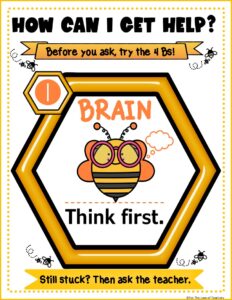 Brain: Stop and Think
The first strategy is to pause and think.
Students can ask themselves:
- What do I already know?
- What do I remember from the directions?
- Have I completed something like this before?
- What could I try first?
Sometimes students know more than they think they do. They may simply need a moment to process the information and recall what they heard.
This step encourages students to slow down instead of immediately saying, “I don’t know.”
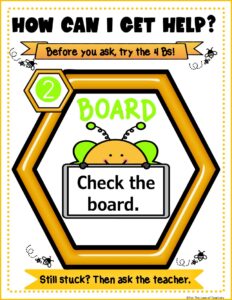 Board: Check the Board
The answer may already be posted somewhere in the classroom.
Students can check:
- written directions
- page numbers
- examples
- anchor charts
- schedules
- materials lists
- classroom reminders
If a student asks, “What page are we on?” and the page number is written on the board, I want the student to develop the habit of looking before asking.
This is not about refusing to answer a question. It is about teaching students to notice and use the supports that have already been provided.
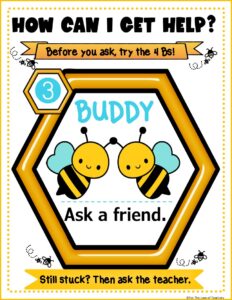 Buddy: Ask a Classmate
Students can also ask a buddy quietly and appropriately.
This does not mean copying someone else’s work or expecting a classmate to complete the task for them. It means asking a specific question that can help clarify the directions.
For example:
“Can you remind me what step we are on?”
“Did the teacher say to write in our notebooks?”
“Can you show me where the directions are?”
Students also need to learn how to be helpful buddies. A helpful classmate explains, points to a resource, or clarifies the direction without simply giving away an answer.
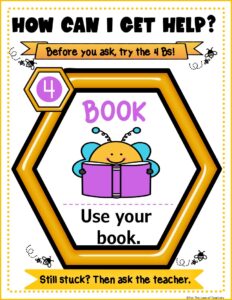 Book: Use a Classroom Resource
The final B is Book, although this can include much more than a traditional book.
Students may use:
- notebooks
- folders
- workbooks
- textbooks
- word walls
- dictionaries
- reference sheets
- classroom charts
- previously completed examples
The idea is to teach students to use the tools that are already available to them.
A student who needs help spelling a word might check a word wall or personal dictionary. A student who forgets how to solve a math problem might look at a worked example in a notebook.
The right resource may help the student move forward without waiting for the teacher.
How to Introduce the 4 Bs
Like any classroom procedure, the 4 Bs need to be explicitly taught.
I would begin by introducing the four strategies during a whole-group lesson. We would discuss what each one means and why independent learners use strategies before asking for help.
Then I would model each B.
I might pretend that I forgot what to do next and think aloud:
“I’m not sure what comes next. Before I ask for help, I’m going to use my Brain. What do I remember from the directions?”
For Board, I would model looking around the classroom for posted directions.
For Buddy, I would demonstrate how to ask a specific question in a quiet voice.
For Book, I would show students how to locate information in a notebook, folder, or classroom reference.
I would also model non-examples.
We could discuss why calling out, copying a classmate, interrupting the teacher, or saying “I don’t get it” without trying anything first does not help us become more independent.
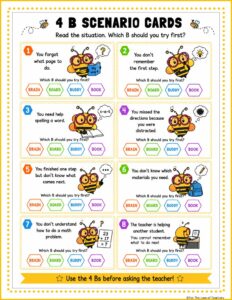 Practice with Classroom Scenarios
Students need opportunities to practice choosing a strategy before they are expected to use the routine independently. Classroom scenarios work well for this.
For example:
- You forgot what page to complete.
- You do not remember the first step.
- You need help spelling a word.
- You missed the directions because you were distracted.
- You finished one step but do not know what comes next.
- You do not know which materials you need.
- You are stuck on a math problem.
- The teacher is helping another student.
Students can decide which B they might try first and explain why. There may be more than one reasonable answer, and that is part of the learning.
A student who is stuck on a math problem may use Brain to recall a strategy, Book to find an example, or Buddy to ask for clarification. The goal is not always to identify one perfect answer. The goal is to choose an appropriate strategy before immediately relying on the teacher.
Use Visual Reminders Throughout the Day
Even after the routine is taught, students will need reminders.
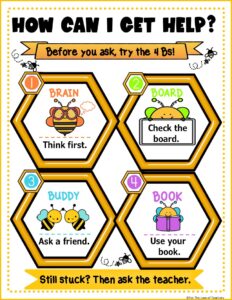
I created mini 4 Bs cards that are approximately the size of a Post-it note. My plan is to place one in the corner of each student’s desk.
That way, when a student asks a question that may be answered independently, I can quietly prompt:
“Which B could help you right now?”
The card gives the student an immediate visual reminder:
- Brain: Think first.
- Board: Check the board.
- Buddy: Ask a friend.
- Book: Use a book or resource.
A small visual can be more effective than another lengthy reminder from the teacher. It keeps the language consistent and helps students internalize the routine over time.
The posters can remain displayed in the classroom, while the desk cards give students a personal reference they can use during independent work, centers, and transitions.
The 4 Bs Do Not Mean Students Cannot Ask for Help
This is an important distinction.
The purpose of the 4 Bs is not to prevent students from asking the teacher for help. It is not a rule that every child must complete four steps before receiving support.
Some students will need repeated directions, additional modeling, visual prompts, or direct teacher assistance. The routine should always be used flexibly based on individual needs.
Students should ask the teacher when:
- they have tried an appropriate strategy and are still confused
- they do not understand the academic content
- the directions are unclear
- they need support that a classmate cannot provide
- they feel unsafe
- someone is hurt
- there is a conflict or serious problem
The final message of the routine is: Still stuck? Then ask the teacher.
Students should know that asking for help is appropriate. The goal is to help them become more thoughtful about when and how they seek it.
Reinforce the Routine All Year Long
Active listening and independence are not lessons we teach once during the first week of school and then consider complete.
The 4 Bs will need to be revisited throughout the year.
Teachers can reinforce the routine by:
- pointing to the classroom poster
- asking students which strategy they tried
- praising students who use resources independently
- practicing new scenarios
- reviewing the routine after a school break
- using the same language consistently
Helpful prompts might include:
“What have you tried so far?”
“Is the answer posted somewhere?”
“Could your notebook help?”
“Is there a buddy who could clarify the direction?”
“You tried a strategy, and you are still stuck. Now I am happy to help.”
Those small moments teach students that independence does not mean doing everything alone. It means using available strategies, making thoughtful choices, and knowing when additional support is needed.
A Ready-to-Use 4 Bs Classroom Routine
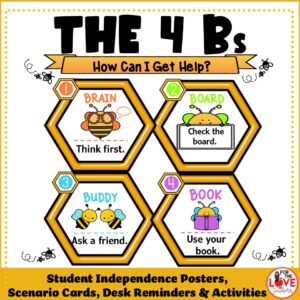
To make the routine easier to teach, practice, and reinforce, I created the 4 Bs Student Independence Classroom Routine. (Shop TPT if you prefer)
The resource includes:
- a teacher guide
- a suggested mini-lesson
- classroom posters
- individual Brain, Board, Buddy, and Book posters
- scenario cards
- sorting activities
- desk reminder cards
- a student response sheet
- a reflection and self-assessment page
- color and black-and-white options
The mini desk reminder cards are designed to fit neatly in the corner of a student’s desk, giving students a quick visual before they ask the teacher for help.
Shop the 4 Bs Student Independence Classroom Routine
The routine also connects naturally to the work we do around active listening, classroom accountability, and independence. Students need to know that the resources around them are not simply decorations. They are tools they can use to solve problems and move forward.
Final Thoughts
If I want students to become more independent, I have to give them more than a reminder to “listen” or “try on your own.”
I have to teach them what independence looks like.
The 4 Bs give students a simple plan: Brain. Board. Buddy. Book.
They can stop and think, check the board, ask a classmate, or use a classroom resource. If they are still confused, they can ask the teacher knowing they have already made a thoughtful effort.
It is a small classroom routine, but small routines often shape the habits students carry with them throughout the year.
What strategies do you teach students to try before asking you for help?
Related Posts:
5 Ways To Promote Active Listening in Your Classroom
7 Ways to Get Your Students To Really Listen
Interactive Modeling- Classroom Management Time Saver
Thanks for reading!
If you like it, then pin it!

Christine Weis is an elementary educator and the creator of For the Love of Teachers, where she shares practical classroom strategies, engaging teaching resources, and real-life ideas to help educators create meaningful learning experiences.

Leave a Reply