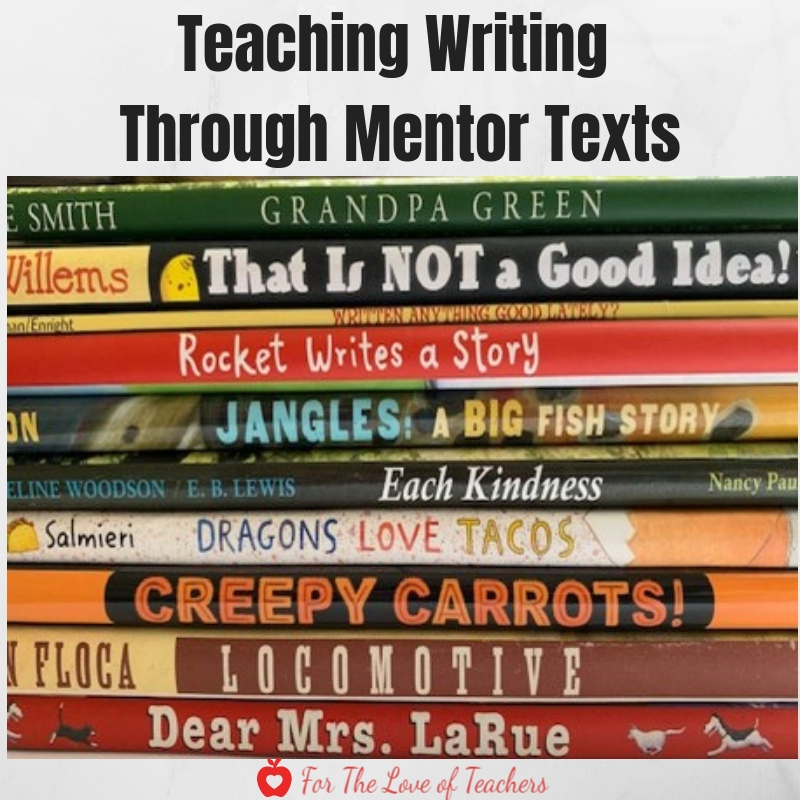
Teaching writing can feel overwhelming, especially when you’re trying to fit it into an already packed elementary schedule. Many students struggle with both reading and writing, making writing instruction even more challenging.
I’ve always believed reading and writing belong together. One of the most powerful ways to teach young writers is through mentor texts, books that model the craft moves, organization, voice, and techniques we want students to use in their own writing.
Over the years, I’ve built a classroom library full of mentor texts that I return to again and again. These books have helped my students write stronger leads, organize their ideas, develop voice, improve sentence fluency, and become more confident writers.
In this post, I’ll share:
- What mentor texts are
- Why they work
- How I use them during Writer’s Workshop
- My favorite mentor texts for elementary students
- Resources that make teaching the Six Traits of Writing easier
What Are Mentor Texts?
A mentor text is any piece of writing that students study to learn a specific writing skill or craft move. While picture books are some of the most popular mentor texts in elementary classrooms, they can also include nonfiction books, poems, magazine articles, essays, and even your own writing.
I regularly share my own writing with my students because I want them to see that writing is a process, even for adults. Some of my favorite teaching moments happen when students give me feedback on my own writing. It reminds them that every writer continues learning and improving.
The goal isn’t to copy an author’s work. Instead, students learn to notice what effective writers do and then apply those same techniques in their own unique way.
Every mentor text has something to teach the writer, whether it be an idea, trait, or skill, that students can learn and apply to their own writing. Students who study the writing from mentor texts, ones that provide strong examples of techniques, transform them into real writers. If you missed my post, Transforming Students Into Writers, you could read it here.
Many, if not all, of my mini-lessons begin with a mentor text that teaches the writer, which is the focus of my mini-lesson. This Mentor Text Clarification & Use by Corbett Harrison at Always Write, definitely helped me to understand better what mentor texts are and how to use them during Writer’s Workshop.
Why Mentor Texts Improve Student Writing
Mentor texts help students:
- understand what good writing looks like
- see writing techniques in authentic books
- develop stronger leads and endings
- expand vocabulary
- improve organization
- strengthen voice
- write with greater confidence
Instead of simply telling students how to write, mentor texts allow them to see expert writers in action.
My Favorite Mentor Texts for Teaching Writing
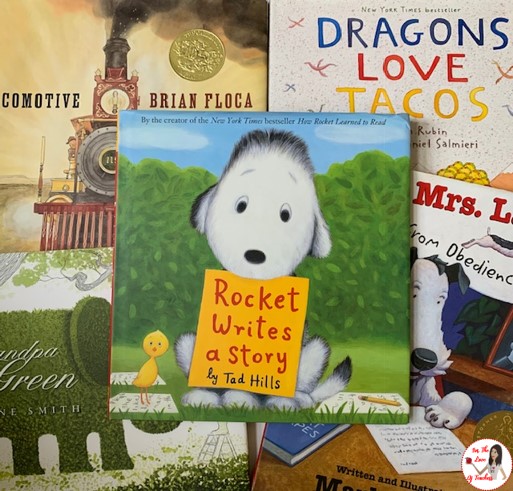
Mentor texts are an essential part of my classroom library. It would help if you had these books in your classroom for ALL grade levels. These gems are used to teach multiple concepts and skills in a variety of genres, and kids of ALL ages LOVE them!
The Day the Crayons Quit

Teaches: Voice, point of view, persuasive writing
Students quickly understand that every character has a unique perspective. It’s one of my favorite books for teaching voice.
Rocket Writes a Story

Teaches: Writer’s process and generating ideas
Perfect for helping reluctant writers discover where ideas come from.
Each Kindness (Jane Addams Award Book (Awards)
Teaches: Theme, reflection, descriptive language
Excellent for teaching students how small details create emotional impact.
Dragons Love Tacos

Best for teaching: Story structure, sequencing, cause and effect, humor, descriptive details, and writing engaging narratives.
This playful story is perfect for showing students how authors build a sequence of events around a simple idea, use descriptive details to make writing more engaging, and create humor through repetition and an unexpected problem.
Written Anything Good Lately?

Best for teaching: The writing process, writer’s workshop, generating ideas, revision, and developing a writer’s mindset.
This book encourages students to see themselves as writers and emphasizes that strong writing develops through planning, drafting, revising, editing, and publishing. It’s an excellent mentor text for launching Writer’s Workshop at the beginning of the school year.
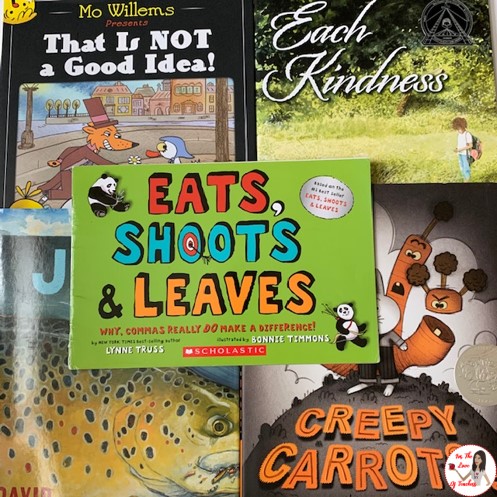
Eats, Shoots & Leaves: Why Commas Really Do Make a Difference!

Best for teaching: Commas, punctuation, conventions, editing, proofreading, and sentence meaning.
This humorous mentor text uses clever illustrations to demonstrate how punctuation can completely change the meaning of a sentence, making grammar instruction memorable and engaging.
Grandpa Green

Best for teaching: Memoir writing, small moments, symbolism, descriptive language, theme, and showing instead of telling.
With beautiful illustrations and sparse but powerful text, this book models how carefully chosen details can tell the story of a person’s life. It’s especially effective for personal narratives, memoirs, and teaching students to “show, not tell.”
Best Mentor Texts for Teaching Voice
The Day the Crayons Quit
Dear Mrs. LaRue: Letters from Obedience School (LaRue Books)

Jangles: A Big Fish Story

Best Mentor Texts for Informational Writing
Manfish: A Story of Jacques Cousteau

Locomotive (Caldecott Medal Book)

You Wouldn’t Want to Live Without Writing!

Best Mentor Texts for Teaching Leads & Endings
That Is Not a Good Idea! Creepy Carrots!


How I Use Mentor Texts During Writer’s Workshop
Step 1: I Do
I introduce a mentor text and model the specific writing strategy I want students to notice. We read like writers, paying close attention to how the author crafted the text.
Step 2: We Do
Together, we discuss the author’s techniques and practice using similar strategies with partners or in small groups.
Step 3: You Do
Students immediately apply the strategy during independent writing. This is where mentor texts become powerful because students transfer what they’ve observed into their own work.
A favorite teaching resource of mine is The Writing Thief, by Ruth Culham, a trait-based strategy to assess and teach writing. I taught my students how to become “writing thieves” through the use of mentor texts. We learned as writers that we should learn from expert writers, and it’s okay to “steal” from these mentor texts and apply new techniques and skills to our own writing.
Teaching the Six Traits Through Mentor Texts
After years of teaching writing, I realized teachers needed ready-to-use lessons that paired mentor texts with focused writing instruction. That’s why I created my Teaching the Six Traits of Writing resources.
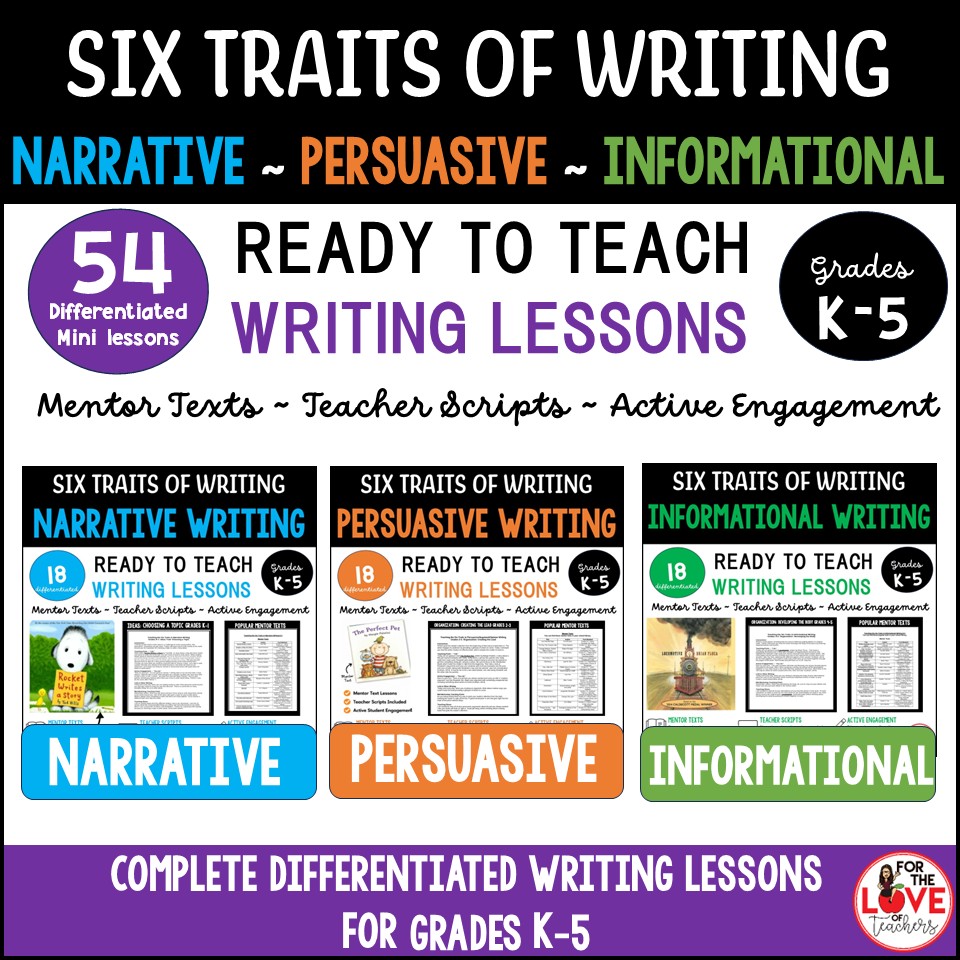
Each lesson includes:
- mentor text recommendations
- differentiated mini-lessons
- grade-level activities
- quick implementation
- grades K–5
The lessons cover:
- Ideas
- Organization
- Voice
- Sentence Fluency
- Word Choice
- Conventions
Free Resource
If you’d like to see how these lessons work before purchasing, download my free Teaching the Six Traits in Informational Writing- Ideas lesson pack. Inside you’ll receive three differentiated lessons for grades K–5 that demonstrate exactly how I use mentor texts during Writer’s Workshop.
You can check out Teaching the Six Traits in Informational Writing here.
More Writing Resources
Teaching the Six Traits in Narrative Writing (K-5, 18 lessons)
Teaching The Six Traits in Persuasive/Opinion/Argument Writing (K-5, 18 lessons)
Teaching The Six Traits of Writing BUNDLE (K-5, 54 lessons)
OR Grade level bundles: K-1, 2-3, and 4-5
The Six Traits of Writing Sticky Notes, Posters, and Student Reference Checklists are a must-have during Writers Workshop. As we teach and encourage students to become confident writers, we must give them the tools they need to be successful. This resource is especially helpful for teaching and reinforcing the 6 traits of writing. Check this resource out here.
Ready to Make Writing Easier?
If you’re looking for ready-to-use writing lessons that pair perfectly with mentor texts, browse the complete Six Traits collection here.
And don’t forget to join my email community for free writing resources, classroom ideas, and exclusive teacher freebies delivered straight to your inbox.
If you like it, then pin it!
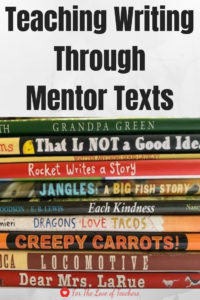
This post contains affiliate links. Any of these books could be purchased on Amazon.com. For The Love of Teachers is a participant in the Amazon Services LLC Associates Program, an affiliate advertising program designed to provide a means for us to earn fees by linking to Amazon.com and affiliated sites at no additional cost to you.
Christine Weis is an elementary educator and the creator of For the Love of Teachers, where she shares practical classroom strategies, engaging teaching resources, and real-life ideas to help educators create meaningful learning experiences.

I am studying to being a teacher and they are so helpful and I can use this for mu class work, I was need new ideas
That’s fantastic! I’m glad it helped! Let me know if there is anything else I could do to support you through your studies. Best wishes!
Christine at For The Love of Teachers
This was so interesting. I have never heard of mentor texts before! I will have to keep this in mind as my boy will be starting kindergarten this next year and all the homework begins!
Thank you! Wow…starting kindergarten…fun!!! He’ll love it! I hope he enjoys books as much as I do. Thanks for reading!
Christine at For The Love of Teachers
This was so insightful! We are big readers with our kids, but I have never heard the concept of “mentor texts” before. I will definitely be adding a few of these books to my “to purchase list”.
I’m so glad! There are so many books that “teach.” I hope you make some good purchases. You’ll love them and your kids will thank you! 🙂
Christine at For The Love of Teachers
My husband is in school for middle childhood education and to see what you guys do to teach our kids is nothing short but amazing! I love these resources you’ve shared with us.
That’s fantastic! Thanks so much for this compliment!! I, on behalf of all teachers, appreciate it! Thanks for reading!
Christine at For The Love of Teachers
Awesome… Every teacher and parent should find their way to this article. As a mathd teacher I know fhaf reading and writing are basics in the learning of other subjects.
Many Thanks
Thank you! Agreed…Reading and writing sure are the basics to everything! Thanks for reading! 🙂
Christine at For The Love of Teachers
Thank you so very much for compiling these mentor texts in one list! And for the freebie. I love your framework! Thank you, thank you!
You are very welcome! The framework is a model that I find effective! Hope you could use both the framework and the freebie in your classroom. 🙂
Christine at For The Love of Teachers
These are great recommendations! I know my friends who just became teachers would love these tips. Thanks for sharing.
Thank you! Please share with your teacher friends! Thanks for reading!
Christine at For The Love of Teachers
These are great recommendations! I used to be a teacher and mentor texts are an excellent way to teach writing! We love the Crayon books & my son’s teacher used this to teach him and make his own book! He loved it!
Thanks Sarah! The Day The Crayons Quit is a great book. I think a sequel to this book just came out too. I’m glad your son loved it and I hope it motivated him to write! Thanks for reading!
Christine at For The Love of Teachers
What great tools to have in the classroom! It’s so important to find something that you’ll enjoy using to teach the children. Otherwise they won’t enjoy it either!
Thanks Courtney! I agree! In order for kids to be engaged writers they have to enjoy it! Thanks for reading!
Christine at For The Love of Teachers
Great resource for children! I’m sure many of your students are going to become great writers with these resources!
Thanks Patricia! I bet they will too! Thanks for reading!
Christine at For The Love of Teachers
Wow awesome resource! Not even just for teachers but at home for parents too- thanks!
Thanks Shelby! I’m glad to hear whenever parents find my content helpful! Thanks for reading!
Christine at For The Love of Teachers