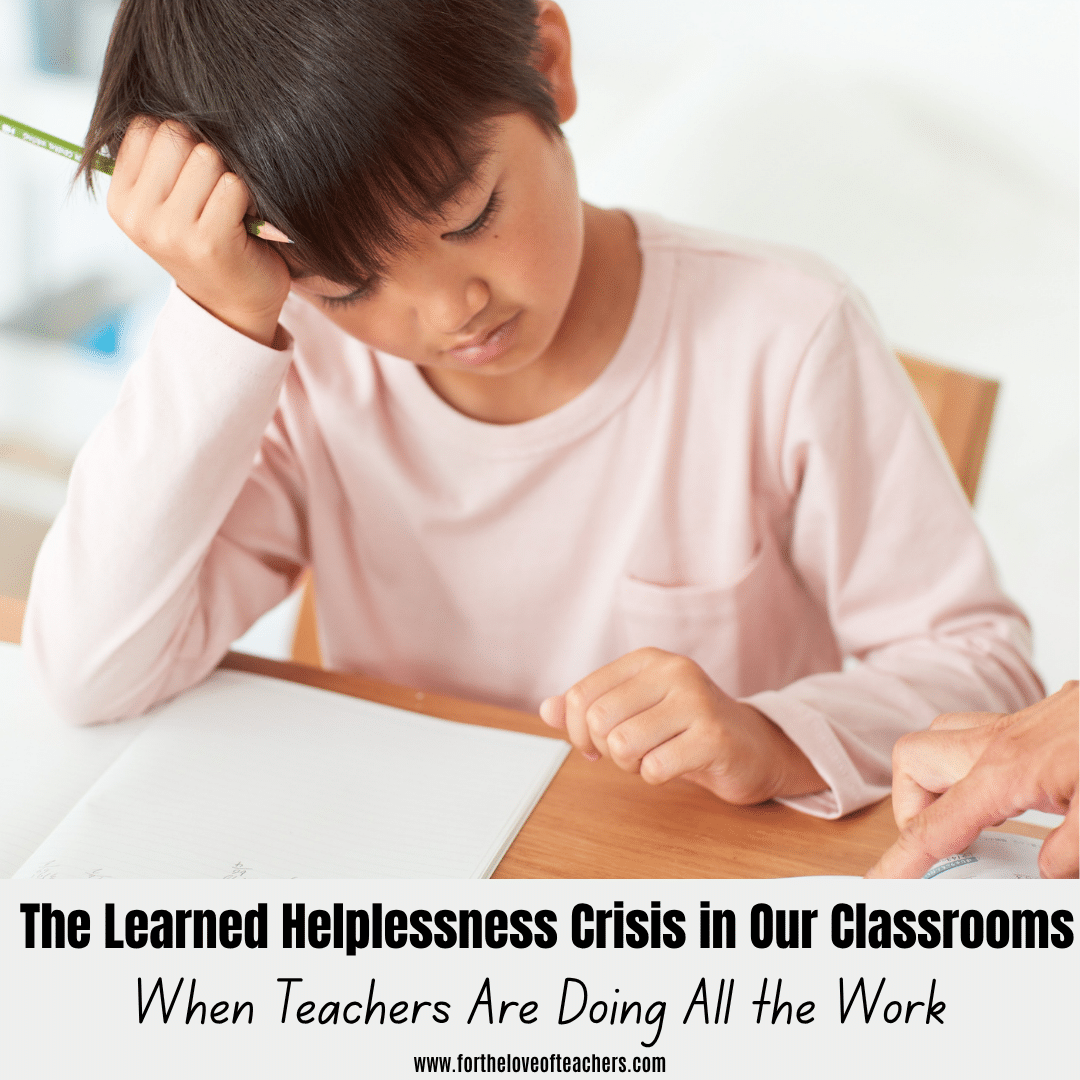
Something is happening in classrooms that we need to talk about.
Students have access to more learning tools, resources, visual supports, and instructional scaffolds than ever before. Teachers spend countless hours planning engaging lessons, differentiating instruction, modeling strategies, and creating opportunities for students to succeed. Yet many educators are noticing a troubling pattern.
Students are struggling to get started, work independently, use available resources, persevere through challenges, problem-solve, and take ownership of their learning.
A student encounters a difficult problem and immediately raises a hand.
Another sits quietly, waiting for someone to tell them what to do.
A student has an anchor chart, checklist, and example right in front of them but does not attempt to use any of them.
Others stop working the moment something requires additional effort.
And when work remains incomplete, the question too often becomes: What could the teacher have done differently?
Not: What strategies did the student attempt?
Not: Did the student use the available resources?
Not: What responsibility can the student begin to take for their learning?
This cycle is exhausting, and teachers cannot break it simply by working harder.
When Helping Becomes Helplessness
As teachers, our instinct is to help. We clarify directions, break down problems, offer examples, provide reminders, and sit beside students who struggle. We do these things because we care.
But we need to ask ourselves an uncomfortable question:
Are we sometimes helping so much that we’re preventing students from developing independence?
Learned helplessness occurs when individuals begin to believe their efforts won’t change an outcome. In classrooms, repeated dependence on adult assistance can sometimes resemble learned helplessness, although not every student who avoids work is experiencing it.
Some students lack confidence. Others struggle with executive functioning, emotional regulation, or academic skills. Some have learning differences and need additional instruction or support. And some have simply become accustomed to adults stepping in before they’ve had to think for themselves.
Whatever the reason, our goal is to help students develop the confidence, strategies, and willingness to try. We must explicitly teach, model, practice, and gradually release independence. Support should lead to independence, not permanent dependence.
The Missing Skill: Productive Struggle
In our efforts to make learning accessible, have we unintentionally communicated that learning should always feel easy? Real learning isn’t always comfortable.
Sometimes students need to reread directions, erase an answer, consult a resource, try another strategy, or make a mistake before finding a solution. That’s productive struggle. Productive struggle doesn’t mean leaving students confused or unsupported. It means providing appropriate challenges, teaching useful strategies, and giving students opportunities to work through difficulties with guidance when needed.
We cannot build problem solvers by solving every problem for them. We cannot develop perseverance by removing every obstacle. And we cannot create independent learners if we’re responsible for every step of the learning process. Sometimes the most powerful thing we can say is: “I know this is challenging. You have strategies you can use. Show me what you can try first.”
When Student Accountability Becomes Teacher Accountability
Perhaps one of the most frustrating parts of this challenge is how quickly responsibility shifts entirely onto teachers.
When students don’t complete assignments, engage in lessons, or use available resources, teachers are often asked what additional interventions they’ve provided.
- Did you differentiate?
- Offer choices?
- Provide visual supports?
- Contact home?
- Give additional reminders?
These are legitimate questions. Effective instruction and appropriate support are essential.
But shouldn’t we also be asking what the student has done to take responsibility for their learning?
- Did they attempt the task?
- Follow directions?
- Use the available resources?
- Ask for help appropriately?
- Make an effort to complete the work?
When we hold teachers accountable for everything but ask students to take responsibility for very little, we create an unsustainable system. Learning is a shared responsibility.
Teachers provide instruction, guidance, and support. Families reinforce learning habits and expectations. Schools establish consistent structures. And students, at a developmentally appropriate level, must learn to participate actively in the process. Student accountability isn’t about blame or punishment. It’s about developing confidence, agency, and responsibility. We should never confuse compassion with the removal of responsibility.
Rebuilding Independence: Teach Students How to Get Started
For some students, the greatest obstacle isn’t completing an assignment. It’s simply getting started.
Instead of repeating directions and providing constant reminders, teach a consistent four-step routine:
READ. THINK. MAKE A PLAN. START.
- READ: What am I being asked to do?
- THINK: What do I already know? What resources could help me?
- MAKE A PLAN: What steps will I take? What should I do first?
- START: Take the first step. I don’t need to know everything before I begin.
Model the process, practice it together, and refer to it consistently during independent work.
When a student says, “I don’t know what to do,” ask:
- “Which step are you on?”
- “What have you figured out so far?”
- “What’s one thing you can do to begin?”
Students who need additional instruction and support should always receive it. But students who are capable of taking the first step need opportunities to practice doing so. Celebrate initiation, not just completion. A student who independently reads directions, gathers materials, and attempts the first problem is demonstrating meaningful progress.
Independence begins with small, intentional habits.
We Cannot Do the Learning for Our Students
Here’s the part we need to remember as educators: We can create the conditions for learning, but we cannot do the learning for our students. We can prepare engaging lessons, provide resources, model strategies, and offer encouragement. But we cannot think, problem-solve, persevere, or take ownership on their behalf. And when we continually rescue students from the very challenges they need to learn to navigate, we risk reinforcing the dependence we’re trying to overcome.
This isn’t about withholding help, lowering expectations, or blaming children for skills they’re still developing. It’s about recognizing that independence grows when students are taught how to handle challenges and given meaningful opportunities to do so. It’s also about protecting teachers from an unsustainable expectation: that every student’s lack of engagement, effort, or completed work is something the teacher alone must fix. Teachers cannot carry the entire responsibility for learning. And working harder isn’t always the answer. Sometimes we need to step back, redirect students to their resources, allow productive struggle, and trust the process of building independence. Our students don’t need us to remove every challenge. They need us to teach them how to face challenges with confidence.
The goal isn’t to create students who can succeed only when a teacher is standing beside them. It’s to develop capable, confident, resourceful learners who know what to do when learning gets difficult.
And that begins when we stop doing the thinking for them.
Are you seeing learned helplessness in your classroom, too? If this post resonates with you, share your experiences in the comments below.
Related Posts:
The Classroom Habit I’m Changing This School Year
How To Teach Students What To Do Before Asking The Teacher For Help
Thanks for reading!

Christine Weis is an elementary educator and the creator of For the Love of Teachers, where she shares practical classroom strategies, engaging teaching resources, and real-life ideas to help educators create meaningful learning experiences.

Leave a Reply